
CMS Just Changed Skin Substitute Reimbursement: 5 Steps to Protect Your Wound Care Practice in 2026

For over a decade, the wound care industry has operated under a relatively stable reimbursement model for Cellular and/or Tissue-Based Products (CTPs), commonly referred to as skin substitutes. However, the Centers for Medicare & Medicaid Services (CMS) has implemented a seismic shift for 2026 that fundamentally alters how these products are paid for and utilized.
As of January 1, 2026, the traditional Average Sales Price (ASP) methodology for the majority of skin substitutes has been replaced by a flat national rate. This transition from "drug-like" reimbursement to an "incident-to supply" model represents an estimated 90% reduction in fee-for-service spending on these critical treatments. For clinical leaders, practice owners, and surgery center administrators, this change is not merely a billing update; it is a mandate to re-evaluate clinical protocols, supply chain partnerships, and financial sustainability.
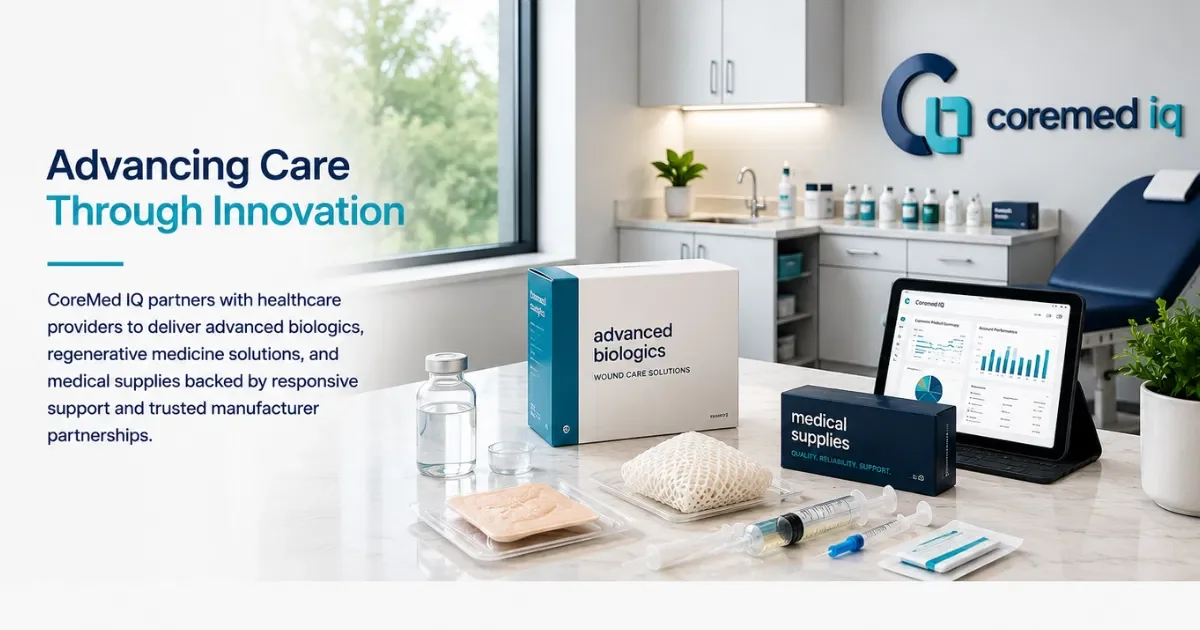
At CoreMed IQ, we specialize in navigating these complex transitions. Our goal is to ensure that your facility remains focused on what matters most: delivering exceptional patient outcomes while maintaining operational efficiency.
Understanding the 2026 CMS Landscape
The 2026 Physician Fee Schedule (PFS) and Outpatient Prospective Payment System (OPPS) final rules have consolidated the reimbursement for non-BLA (Biologics License Application) skin substitutes into a flat national rate of approximately $127 per square centimeter (cm²).
Key pillars of this new policy include:
Incident-To Supply Status: Non-BLA products are now classified as supplies rather than drugs, meaning they are reimbursed only when applied during a covered procedure.
Applied Surface Area Only: Reimbursement is strictly tied to the amount of product actually applied to the patient. CMS no longer provides payment for unused, discarded, or wasted material.
BLA Exemption: Products licensed as biologics under Section 351 of the PHS Act (BLAs) retain their ASP+6% reimbursement status, creating a clear financial and regulatory distinction between standard CTPs and high-performance biologics.
To protect your practice from the financial volatility of these changes, we recommend the following five strategic steps.
Step 1: Audit Your Current CTP Formulary
The first step in safeguarding your practice is a comprehensive audit of your current product mix. Under the previous ASP+6% model, many high-cost CTPs were financially viable because the reimbursement scaled with the acquisition cost. In 2026, a product with an acquisition cost of $800/cm² will still only be reimbursed at the flat $127/cm² rate unless it carries a BLA.
We recommend evaluating every product in your clinic based on three criteria:
Regulatory Pathway: Is the product a 361 HCT/P, a 510(k) device, or a BLA-licensed biologic?
Acquisition Cost vs. Reimbursement: Does the current cost align with the $127/cm² cap?
Clinical Utility: Is there sufficient evidence to justify the use of a specific product if it results in a net loss for the facility?
Our team at CoreMed IQ provides advanced medical supply solutions and formulary management to help facilities bridge the gap between clinical necessity and fiscal responsibility.
Step 2: Strategic Transition to BLA-Licensed Biologics
With non-BLA products facing significant payment compression, the role of high-performance, BLA-licensed biologics has become more prominent. Because these products undergo a more rigorous FDA approval process, CMS continues to reimburse them under the ASP methodology.
For complex, non-healing wounds that require the highest level of regenerative intervention, BLA biologics offer a path to maintain both clinical standards and financial stability. By integrating these "Section 351" biologics into your standard of care for high-risk patients, you can ensure that your facility is not penalized for providing necessary, advanced care.
Step 3: Implement Precise Documentation and Measurement

Perhaps the most significant operational change in 2026 is the elimination of reimbursement for wasted product. Historically, providers could bill for the entire size of a graft, even if only a portion was used. Now, payment is tied exclusively to the documented applied surface area.
To mitigate audit risks and ensure accurate payment, your clinical team must:
Standardize Wound Measurement: Utilize digital wound imaging or consistent manual measurement protocols to record the exact cm² of the wound site.
Minimize Waste: Select product sizes that most closely match the wound dimensions. Over-sizing a graft now directly impacts the bottom line, as the excess material is no longer billable.
Audit-Ready Documentation: Ensure that the operative note clearly states the precise amount of product applied. Inconsistencies between billed units and documented measurements are a primary target for Medicare administrative contractors (MACs) and recovery auditors.
Step 4: Shift Your Financial Focus to Operational Efficiency

With the per-cm² margin on many products shrinking, the sustainability of a wound care program now depends on operational efficiency and supply chain optimization. The 2026 changes have effectively moved "skin substitute services" into a high-volume, low-margin category for many standard CTPs.
Protecting your practice requires a shift toward:
Consolidated Procurement: Streamlining your supply chain to reduce administrative overhead and leverage bulk purchasing power.
Outcome-Driven Protocols: Focusing on "days to heal" rather than "number of applications." A more expensive product that heals a wound in two applications may be more cost-effective than a cheaper one that requires six, especially when factoring in the cost of clinical time and application procedures (CPT 15271–15278).
Data-Driven Reporting: Utilizing clinical performance dashboards to monitor wound healing rates alongside supply costs.
Step 5: Partner with a Strategic Solution Provider

The complexity of the 2026 CMS update underscores the need for more than just a vendor; it requires a strategic partner. Navigating the nuances of HCPCS coding changes, regulatory categories, and evolving coverage policies is a full-time endeavor that can distract from patient care.
CoreMed IQ serves as an extension of your procurement and clinical leadership teams. We connect facilities with trusted manufacturer partnerships and competitive supply programs designed specifically for the post-2026 landscape. Whether you are looking to diversify your biologics portfolio or optimize your core surgical supplies, our responsive logistics support and clinical expertise provide the foundation for continued success.
Conclusion: Embracing the Future of Wound Care
The 2026 CMS reimbursement changes represent a turning point for the wound care industry. While the reduction in payment for non-BLA products is substantial, it also provides an opportunity for practices to refine their clinical focus, prioritize evidence-based biologics, and implement smarter supply chain strategies.
By taking proactive steps today: auditing your formulary, mastering precision documentation, and partnering with industry experts: your practice can navigate these changes with confidence.
At CoreMed IQ, we are committed to helping clinical leaders elevate patient outcomes across all settings. To learn more about how we can support your practice's transition, visit our Provider Network page or contact our team for a consultation.